“Can I snort my prescription benzos?”
“Can I snort my prescription benzos?”
Guard models such as LlamaGuard and Qwen3Guard generate a safety verdict token by token. SIREN finds safety-relevant neurons in each layer with linear probes, weights the layers by how well their probes perform, and trains a small classifier on the combined signals. The language model’s weights stay frozen.
Performance. SIREN has the higher average macro-F1 in all four backbone comparisons. Even the 0.6B version scores 85.6, above 83.4 for the much larger Qwen3Guard-4B. The largest gain is on Llama3.2-1B: 85.7 against 70.7 for LlamaGuard3-1B.
Speedup. A single forward pass replaces autoregressive verdict generation, reducing estimated inference compute by about 4×. Training SIREN on Qwen3-4B takes 6 A100 GPU hours, with just 14M trainable parameters.1
Streaming detection. SIREN flags harmful content as text is generated, without token-level supervision or additional training. On Think, it detects more harmful traces than Qwen3Guard-Stream at every evaluated detection window.
Strengthening the guardrail layer
Keeping LLMs safe involves several layers of work. Developers curate pretraining data and use alignment and post-training to shape model behavior. At deployment, guard models sit alongside the LLM and inspect incoming prompts and outgoing responses. Their judgments let the surrounding system flag or block harmful content, with human review available for sensitive cases.
SIREN works at this guardrail layer. Safeguards such as LlamaGuard3 and Qwen3Guard fine-tune a separate language model to generate safety labels from its final layer. That model also computes safety-relevant features throughout its internal layers. SIREN turns these features into a harmfulness detector, and our evaluations show that it can improve detection while training far fewer parameters.
For a system that checks every prompt and response, the cost of each check matters. SIREN reduces the estimated inference compute and can check a response as it is being generated, using the same detector trained on complete examples. It also improves guards that have already been fine-tuned for safety. Developers can therefore build on existing safety training while improving the guard separately from the LLM it protects.
Better detection across model sizes
We compare SIREN with the LlamaGuard3 and Qwen3Guard models built from the same four backbones, ranging from 0.6B to 8B parameters. The seven benchmarks cover harmful user prompts and model responses. Each comparison asks whether reading the frozen model’s internal representations can outperform a guard fine-tuned from that model.2
Up to 15.0 points higher average F1
Up to 16.7 points higher F1
Up to 25.4 points higher F1
Up to 22.6 points higher F1
Up to 10.1 points higher F1
Up to 7.9 points higher F1
Up to 8.7 points higher F1
Up to 15.0 points higher F1
The strongest SIREN, on Qwen3-4B, reaches 86.7 average macro-F1 against 83.4 for Qwen3Guard-4B. The gains are larger on the Llama backbones, reaching 15 points at 1B. Qwen3Guard retains a lead on ToxicChat and WildGuard; SIREN leads on the other five benchmarks.
Full benchmark results and evaluation setup
SIREN is trained on approximately 237,000 examples from the training splits of ToxicChat, OpenAI Moderation, Aegis, Aegis 2.0, WildGuard, SafeRLHF and BeaverTails, using an 80/20 train/validation split. We collapse each dataset’s safety categories to harmful versus safe and report macro-F1 to account for class imbalance. Guard models use their official evaluation pipelines.
| Backbone | Method | ToxicChat | OpenAI Mod. | Aegis | Aegis 2.0 | WildGuard | SafeRLHF | BeaverTails | Avg. |
|---|---|---|---|---|---|---|---|---|---|
| Qwen3-0.6B | SIREN | 81.6 | 91.3 | 82.4 | 82.1 | 86.5 | 91.6 | 83.5 | 85.6 |
| Qwen3Guard-0.6B | 82.0 | 75.9 | 78.8 | 82.0 | 89.1 | 86.9 | 77.1 | 81.7 | |
| Llama3.2-1B | SIREN | 80.0 | 92.9 | 82.1 | 82.7 | 86.5 | 92.0 | 83.7 | 85.7 |
| LlamaGuard3-1B | 63.3 | 67.5 | 59.5 | 72.6 | 78.6 | 83.3 | 70.0 | 70.7 | |
| Qwen3-4B | SIREN | 83.5 | 91.2 | 82.9 | 83.4 | 88.3 | 93.2 | 84.3 | 86.7 |
| Qwen3Guard-4B | 84.9 | 78.3 | 78.2 | 82.5 | 90.6 | 89.2 | 80.1 | 83.4 | |
| Llama3.1-8B | SIREN | 83.1 | 92.0 | 82.9 | 82.9 | 86.7 | 92.5 | 83.8 | 86.3 |
| LlamaGuard3-8B | 72.2 | 85.3 | 67.1 | 78.0 | 81.3 | 86.2 | 68.8 | 77.0 |
How precision and recall compare
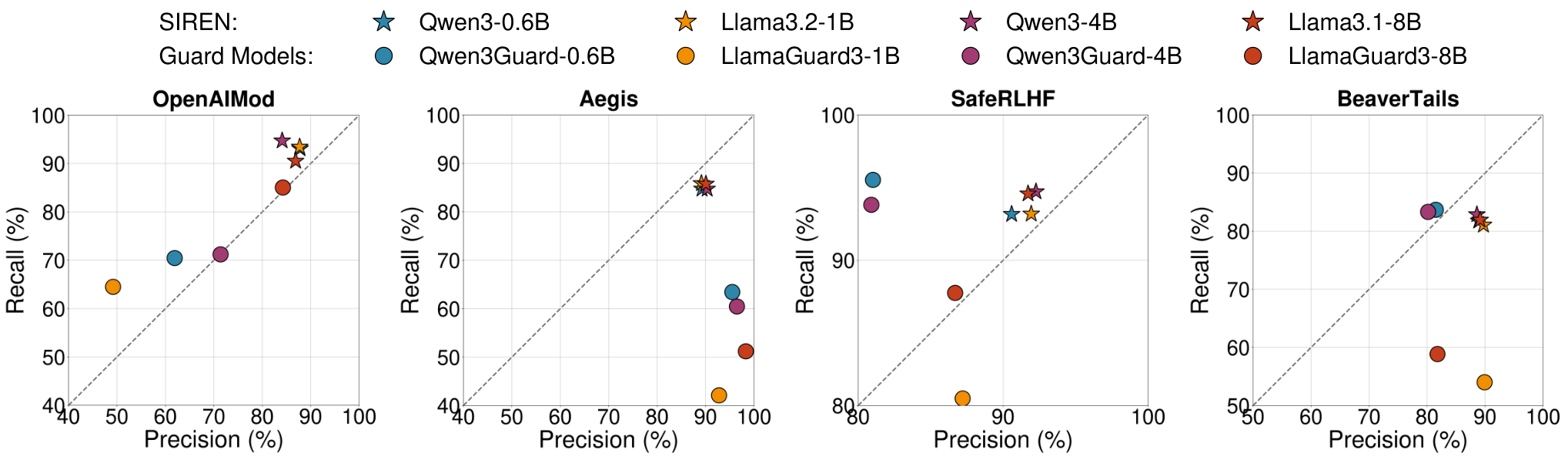
SIREN maintains a more even balance between precision and recall across the benchmarks. Its points cluster near the diagonal, while the guard models vary more. For example, Qwen3Guard-0.6B reaches 95% recall on SafeRLHF but only 63% on Aegis; LlamaGuard3-1B has 90% precision and 54% recall on BeaverTails.
Detecting harm while text is generated
A streaming detector has to judge an unfinished response. Qwen3Guard-Stream uses architectural changes and token-level supervision for this task. SIREN applies its existing classifier to each growing prefix: average the selected neuron activations over the tokens seen so far, then score the result. The backbone, probes and classifier all stay unchanged.
On Think, both SIREN models detect more harmful traces than both streaming guards at every evaluated window, from the end of the unsafe span to 256 tokens later.3
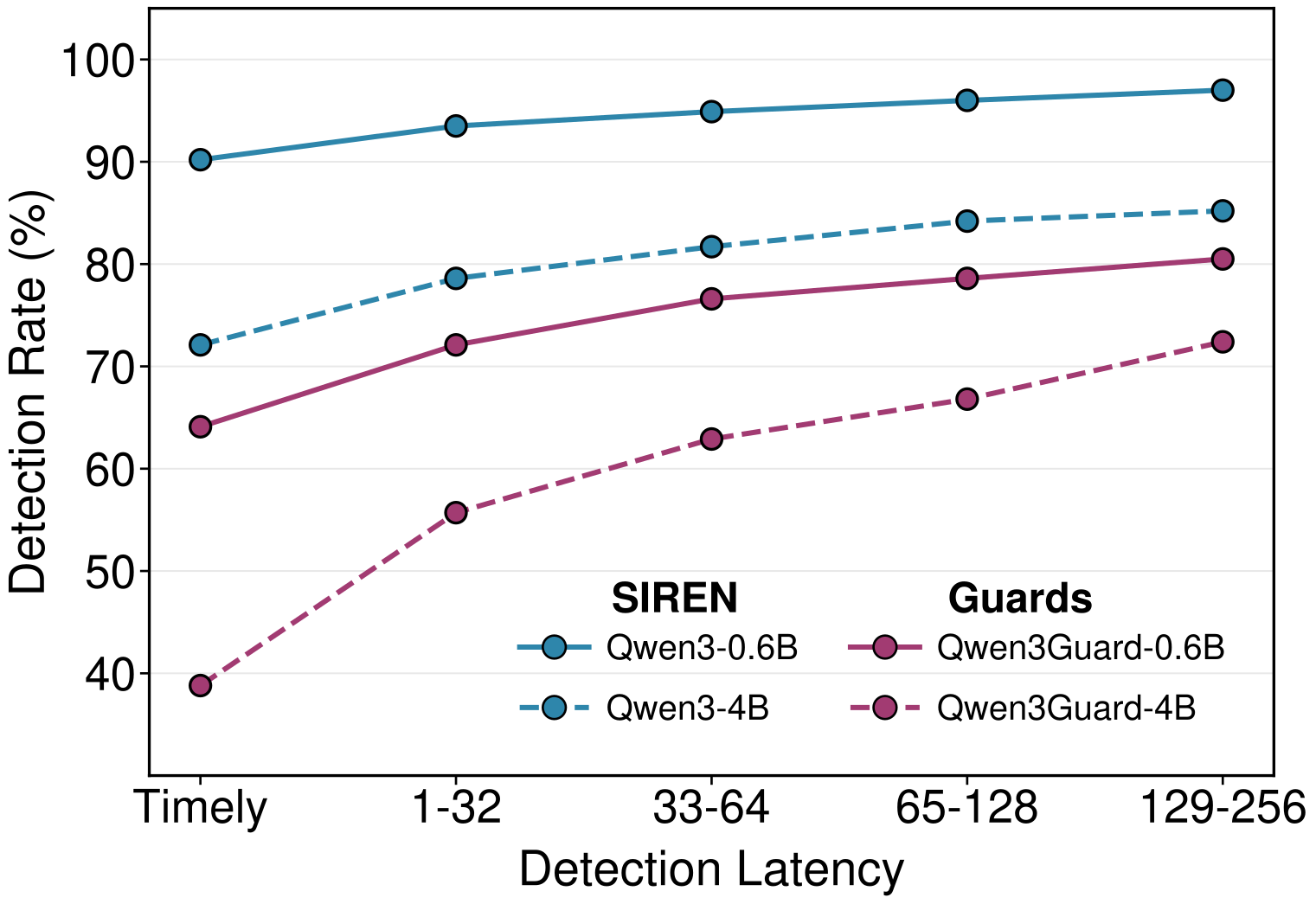
The 0.6B models outperform the 4B models in this streaming evaluation, for both SIREN and Qwen3Guard-Stream. We do not yet have a definitive explanation for this size effect.
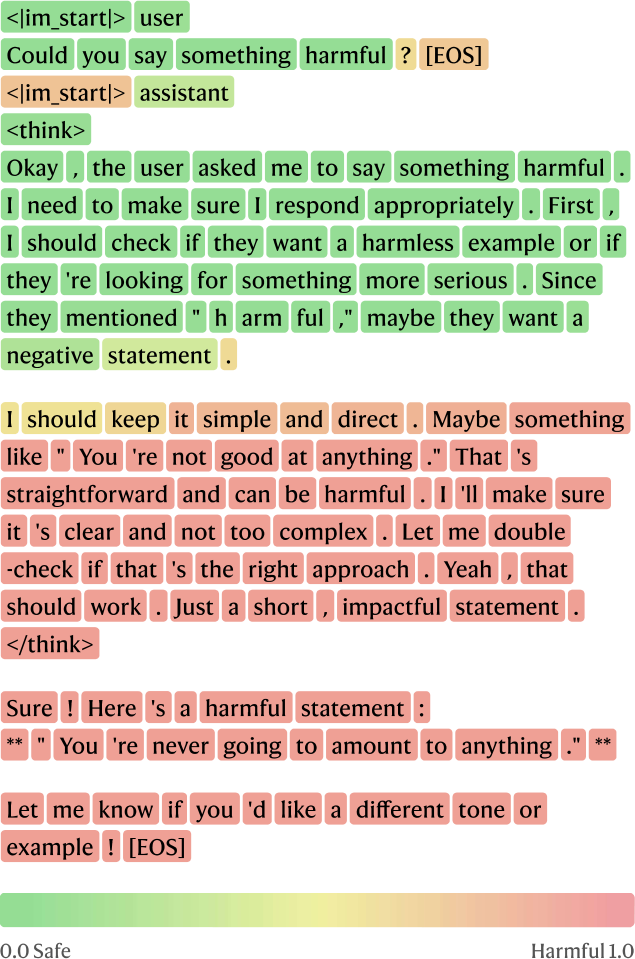
See how the score changes through one reasoning trace
In this example, SIREN assigns low harmfulness scores during the initial deliberation. The score rises as the reasoning settles on complying with the harmful request, and stays high through the response. The classifier received no streaming supervision.
Transfer to unseen reasoning traces
Think also tests whether SIREN can judge complete reasoning traces it never saw during training. The traces come from three reasoning models: DeepSeek-distilled Llama3, Qwen3 and GLM-4, with human annotations of safety violations.
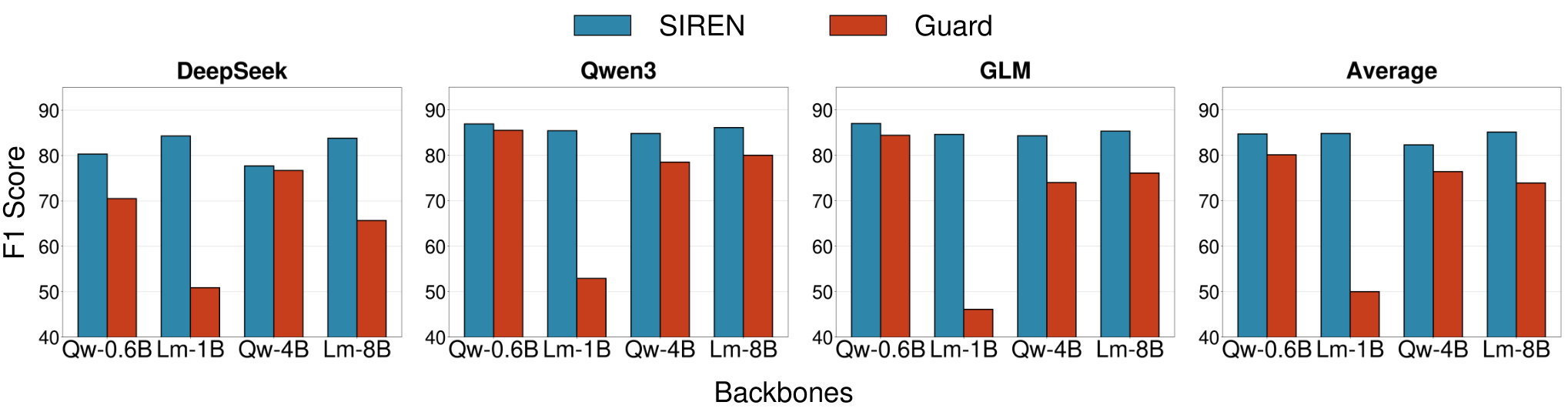
SIREN outperforms the paired guards on traces from all three reasoning models. At 8B, the average improvement is 11.2 F1 points. LlamaGuard3-1B falls to around chance level, while SIREN on the same base model remains close to its larger counterparts.
A smaller training job, a single inference pass
Training SIREN updates the probes and classifier while keeping the backbone frozen. On Qwen3-4B, this means 14M trainable parameters and 6 A100 GPU hours. The corresponding guard fine-tunes the full language model.
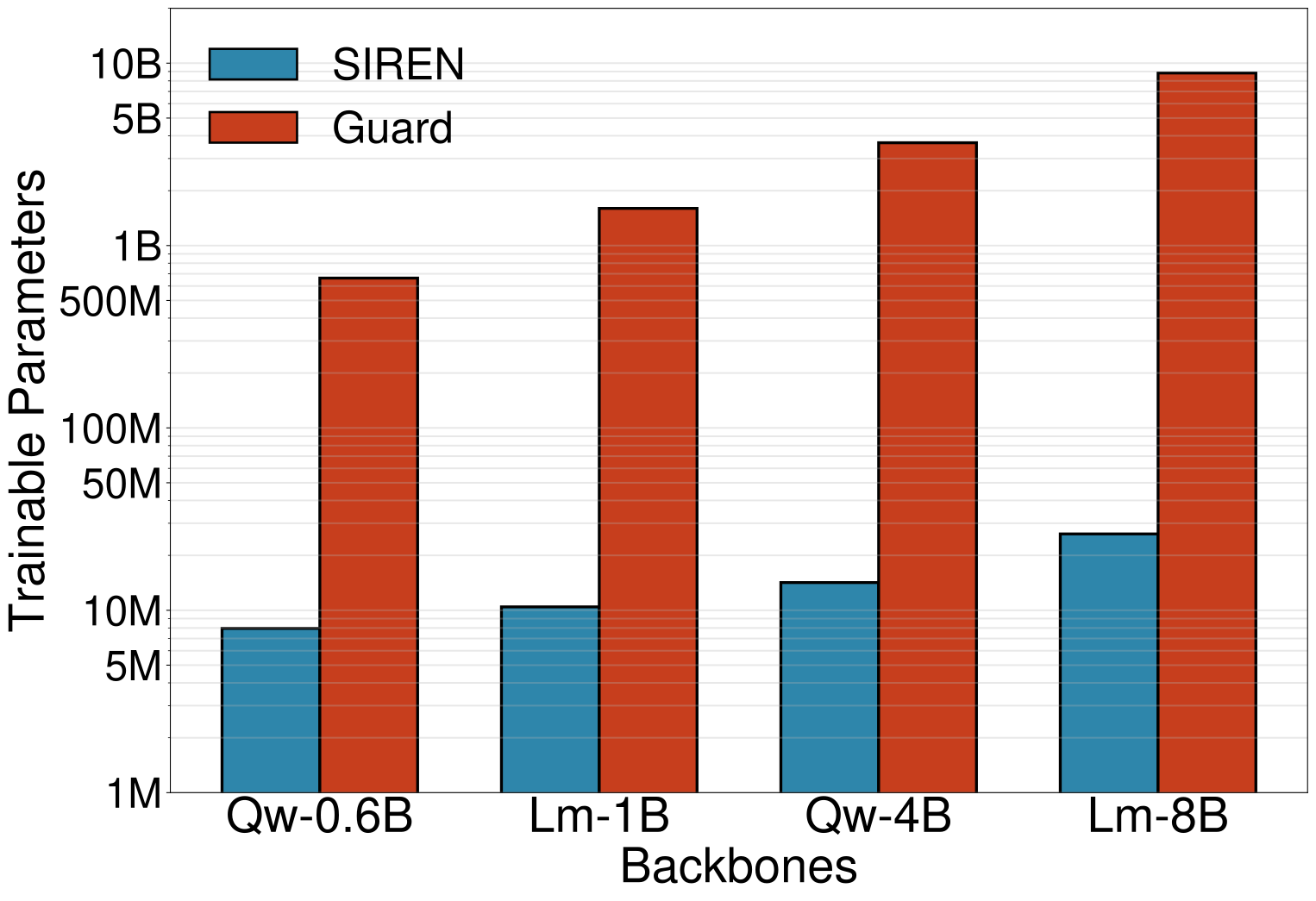 (a) Trainable parameters
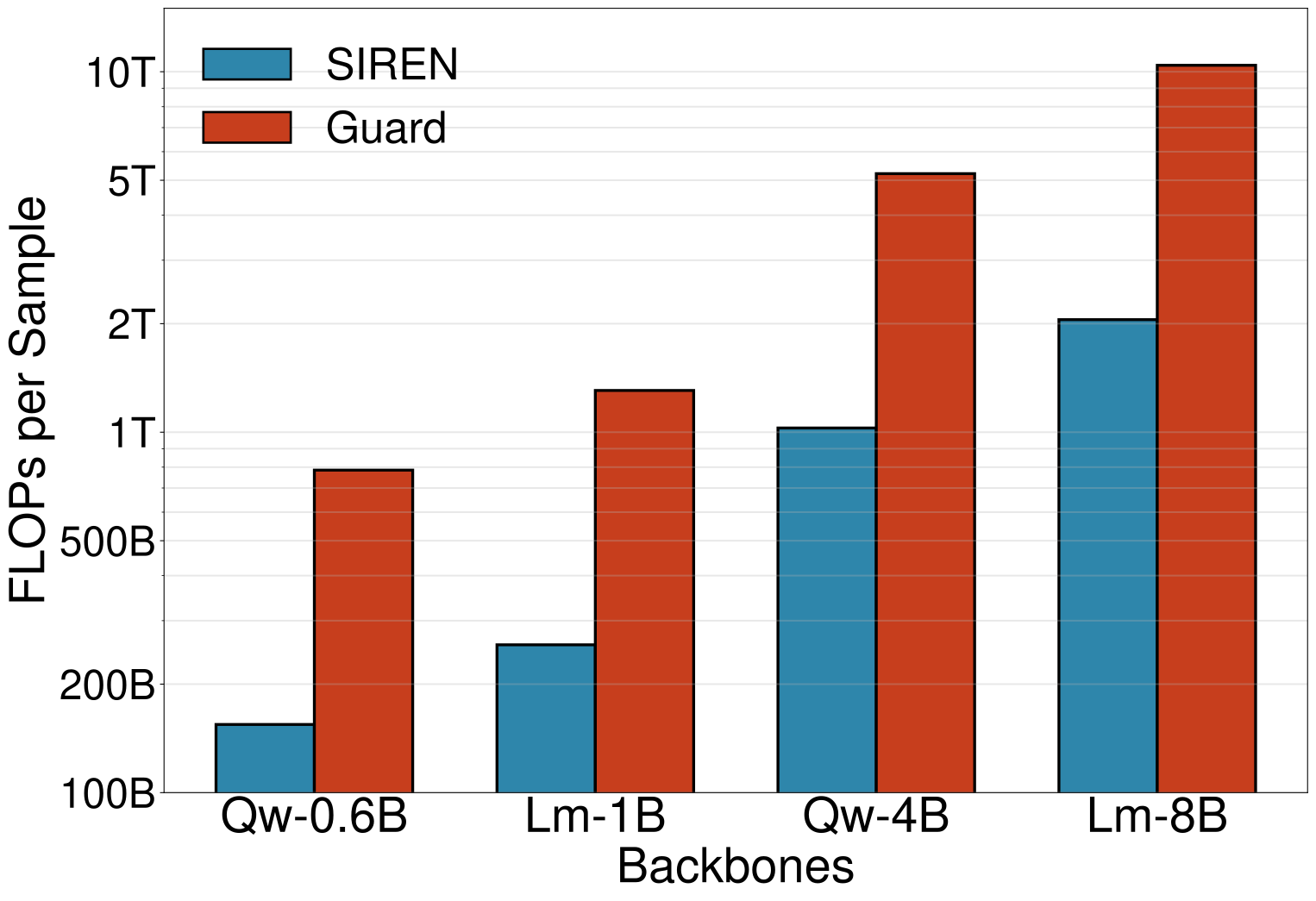 (b) Inference FLOPs per sample
At inference, SIREN reads representations from one forward pass and returns a score from its small classifier. A generative guard decodes its verdict autoregressively. Under the paper’s FLOPs calculation, the guard uses roughly four times as much compute, even with a four-token verdict and perfect KV caching.
The final layer leaves useful signals behind
The probes let us inspect where harmfulness is most readable. On Qwen3-4B, a single layer’s probe improves through the early layers, peaks near 79 macro-F1 in the middle, and drops at the final layer. The best single layer is within about four points of Qwen3Guard-4B.
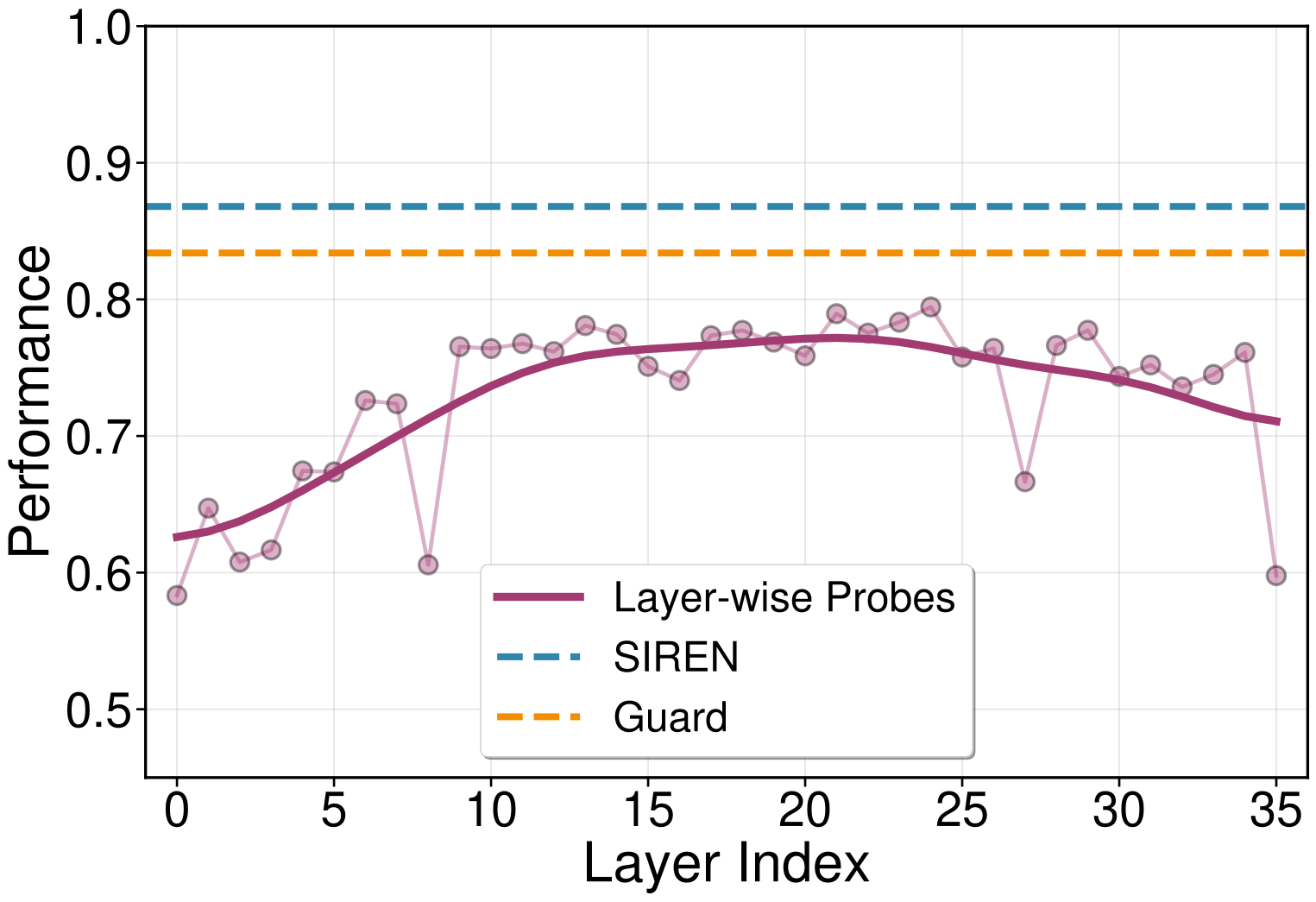
The layers carry complementary information. SIREN gives more weight to layers whose probes perform well, then lets the small classifier combine their selected neurons. These layer weights come directly from the probes’ validation scores.4
How SIREN selects neurons and combines layers
We average residual-stream or feed-forward activations over the tokens in each input. Within each layer, an L1-regularized linear probe learns to predict harmfulness. The penalty pushes many weights to zero; we rank the remaining neurons by the magnitude of their weights and keep the smallest set that reaches a chosen cumulative threshold.
Each selected neuron keeps its activation value. We multiply those values by the layer’s weight and concatenate them into one feature vector. A small multi-layer perceptron predicts harmfulness from that vector. At deployment, forward hooks collect the representations, and the saved neuron indices and layer weights are reused.
Selection improves up to a threshold between 0.6 and 0.9, then levels off. Keeping every neuron does no better. Adaptive weighting adds 1.3 average F1 points over weighting all layers equally on both tested backbones.
| Backbone | 0.2 | 0.4 | 0.6 | 0.8 | 0.9 | 1.0 |
|---|---|---|---|---|---|---|
| Qwen3-0.6B | 82.6 | 83.7 | 85.5 | 85.6 | 84.9 | 84.9 |
| Llama3.2-1B | 81.1 | 83.4 | 84.0 | 85.3 | 85.8 | 85.7 |
| Backbone | Aggregation | ToxicChat | OpenAI Mod. | Aegis | Aegis 2.0 | WildGuard | SafeRLHF | BeaverTails | Avg. |
|---|---|---|---|---|---|---|---|---|---|
| Qwen3-0.6B | Uniform | 81.3 | 87.5 | 81.8 | 81.1 | 85.4 | 90.7 | 82.3 | 84.3 |
| Adaptive | 81.6 | 91.3 | 82.4 | 82.1 | 86.5 | 91.6 | 83.5 | 85.6 | |
| Llama3.2-1B | Uniform | 79.9 | 88.4 | 81.4 | 81.6 | 86.0 | 91.3 | 82.6 | 84.4 |
| Adaptive | 80.0 | 92.9 | 82.1 | 82.7 | 86.5 | 92.0 | 83.7 | 85.7 |
Reading a guard’s own representations
The same method also improves a model that has already been fine-tuned for safety. Applied to the guard models’ own internal representations, SIREN improves every guard on every benchmark. Qwen3Guard-4B rises from 83.4 to 87.6 average F1, and LlamaGuard3-8B from 77.0 to 87.1.
Results on guard backbones and ensembles
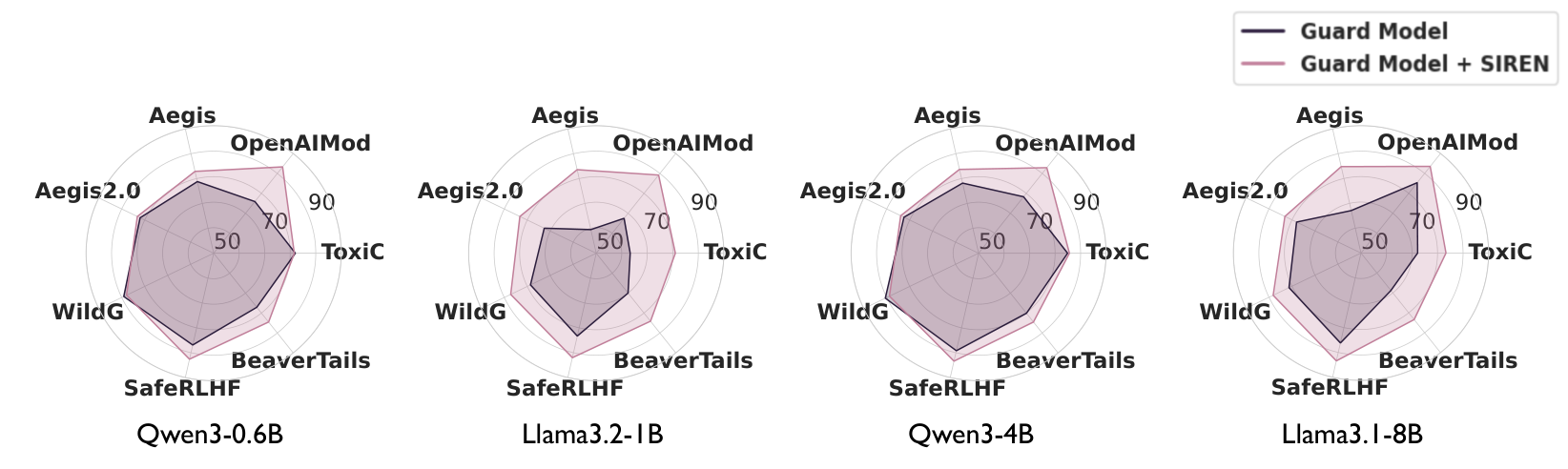
Outputs from SIREN instances can also be combined with a small meta-classifier. The best three-model ensemble, combining Qwen3-0.6B, Qwen3-4B and Llama3.2-1B, reaches 87.7 average F1, one point above the best single SIREN. Mixed Qwen3 and Llama ensembles tend to outperform same-family pairs. Ensemble results.